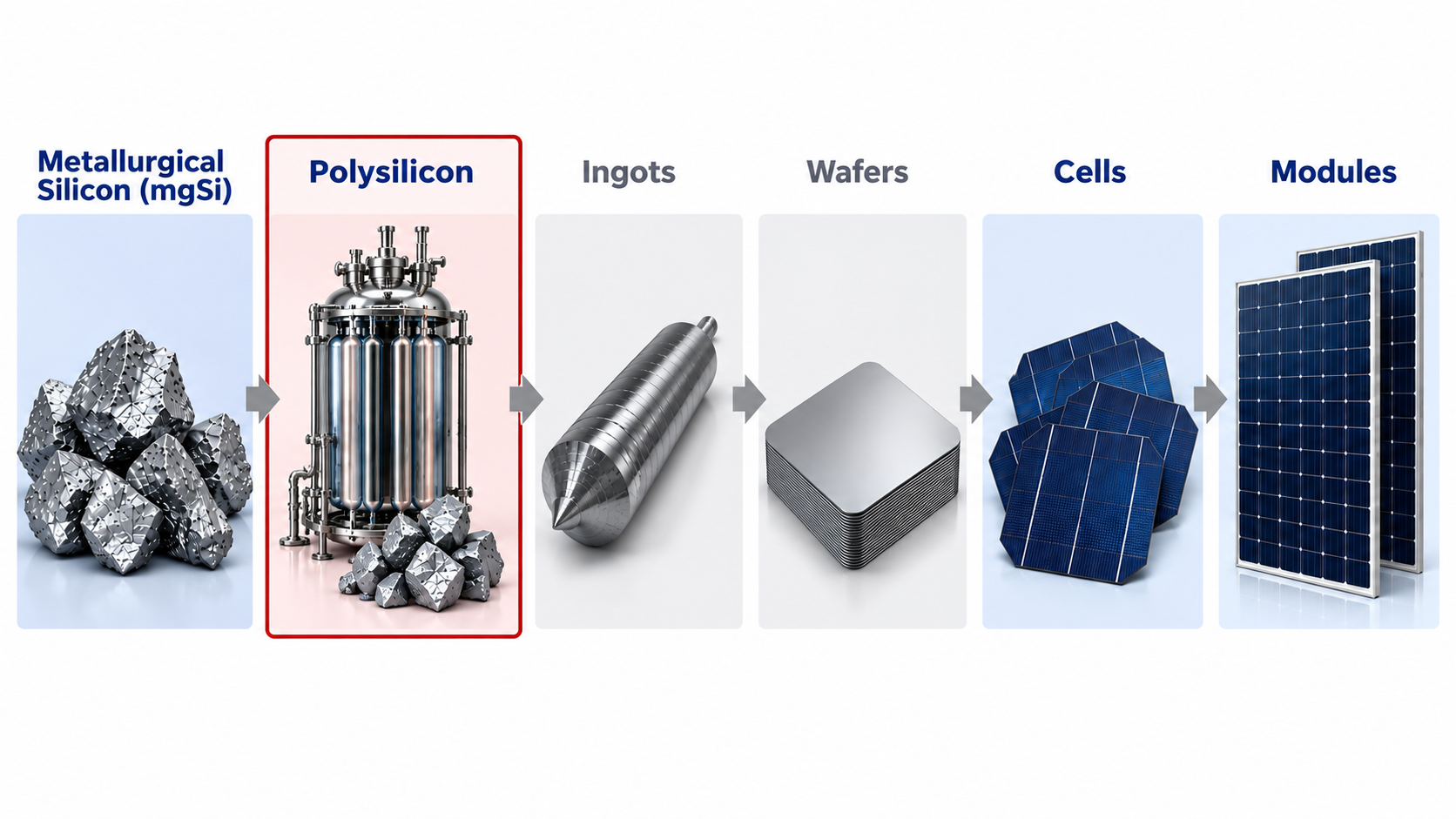
Europe has the ambitions, technologies, projects and expertise needed to build strategic manufacturing capacity.
But turning those ambitions into reality requires greater investment certainty and a policy framework that supports industrial development.
The recent HCSS report The silicon economy warns that Europe risks falling behind in polysilicon unless it addresses distorted market conditions, provides investment certainty and enables new industrial capacity to develop rapidly.
The report highlights a particular challenge. Silicon metal is covered by the EU’s Critical Raw Materials Act, while its highly refined derivative, polysilicon, falls under the Net-Zero Industry Act. Yet polysilicon projects face many of the same investment challenges as critical raw-material projects.
Creating the conditions for investment
The European Solar Manufacturing Council (ESMC) identifies similar challenges across the solar value chain. European companies already have concrete investment plans, but need a predictable market framework that values resilience, diversification, innovation and European production.
ESMC calls for faster implementation of the Industrial Accelerator Act, measures to address systemic overcapacity and distorted competition, and financial and operating support to attract private investment.
RESiLICON is one of the European projects seeking to translate these industrial ambitions into new manufacturing capacity. Recognised as a Strategic Project under the EU’s Net-Zero Industry Act, its planned polysilicon facility in the Netherlands illustrates the importance of creating conditions that allow projects to secure investment and progress towards construction.
These investment conditions will help determine how much of Europe’s future solar and semiconductor value chains can be built in Europe.
Interested in working with RESiLICON? Whether you’re a potential customer, investor or strategic partner, we’d welcome a conversation. Contact us today.
Image: ESMC graphic